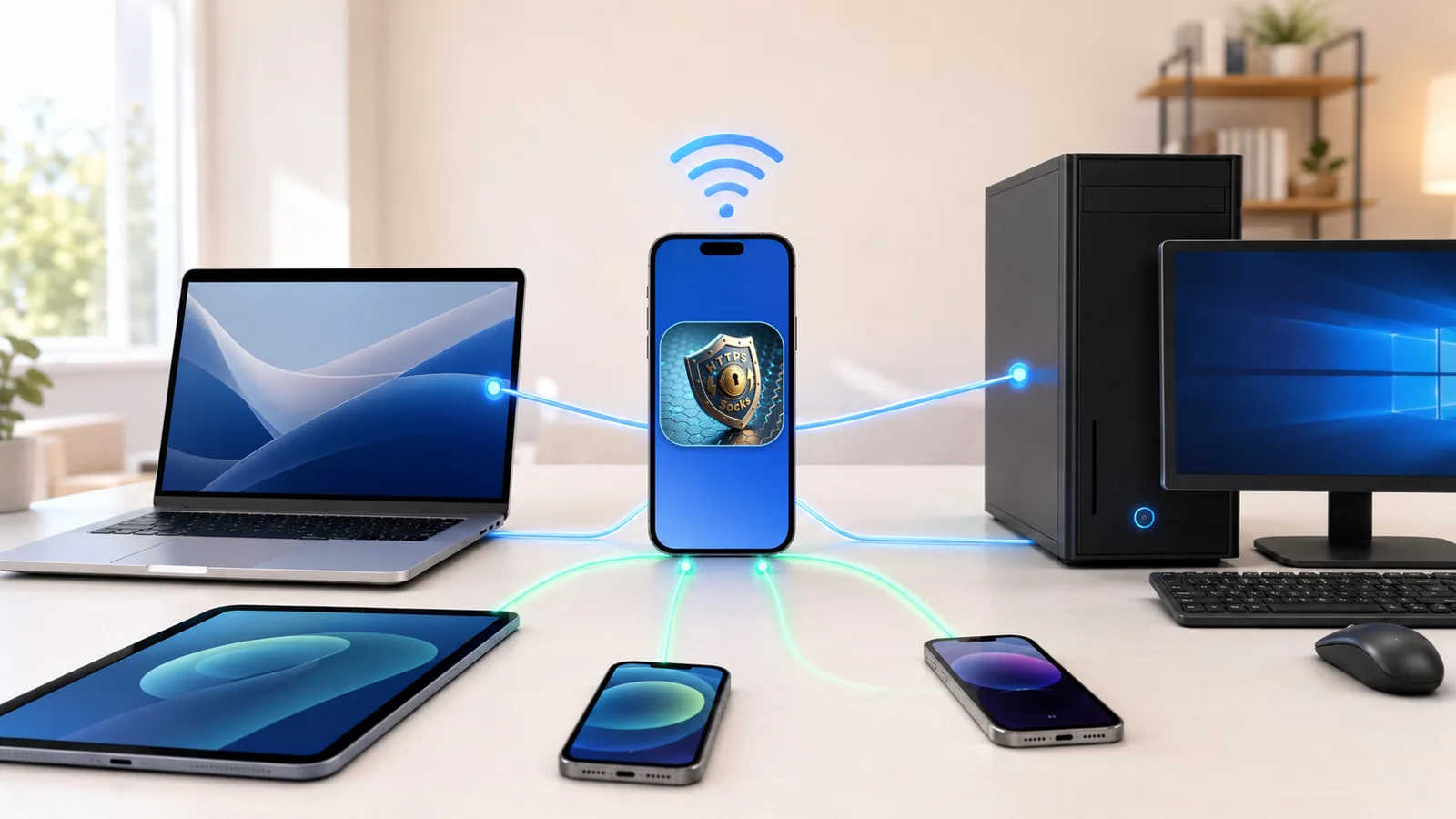
Latest note
MonoProxy 2.8.3 adds Siri and Shortcuts automation, network-aware proxy profiles, SOCKS5 UDP relay, clearer stop notifications, and stronger connection recovery.
MonoProxy Siri Shortcuts SOCKS5 UDP iPhone proxy networking
Why we built Lumenfold: a Metal-powered gallery where mathematical artworks move with their own soundscapes and can fill a larger screen.
SignalMetric 2.0 aligns iOS and Android around file checks, recording preparation, A/B comparisons, environment noise and a redesigned instrument workspace.
MonoProxy 2.4.0 improves large transfers, uploads, Range requests, long-lived sessions, local setup, and network diagnostics on iPhone and iPad.
The everyday storage and copy-paste problem that led us to design optional PIN protection and QR transfer for private space Access Keys.
Senvra 1.3 adds portable encrypted backup and restore, personal space skins, a free starting plan, and a more complete on-device media experience.
MonoProxy 2.3.1 brings a clearer local proxy workflow, stronger client controls, better diagnostics, and more reliable transfers to iPhone and iPad.
A practical explanation of Senvra's password, Space Access Key, master-key wrapping, and local encryption boundary.
How private-space backups use the source Space Access Key, why public-space backups are not confidential, and how Senvra verifies saved files before recovery.
Aug 22, 2026
A controlled comparison of 10 compact GGUF models, including Llama 3.2, SmolLM, and LFM2.5, with iPhone 4K/8K resource data and a 96-case bilingual Agent test.
Aug 22, 2026
A focused iPhone 15 Pro Max test of Qwen3.5-2B with 3,584- and 7,680-token prompts, measuring prefill, TTFT, generation, memory, and thermal state.
Aug 22, 2026
Our phone-local model test design, with all 96 bilingual cases and expected routes, structured metrics, fixed decoding, iPhone resource runs, evidence, and limits.
A practical look at Senvra’s trusted-device assumptions, authenticated encryption, recovery design, and protections for real-world interruptions.
A source-first workflow for learning the meter, inspecting live audio and files, and creating an explicit local recording only when needed.
How SignalMetric keeps its live meter, spectrum, timeline, and waveform views coherent without allowing real-time work to become a UI backlog.
A practical guide to the different questions answered by dBFS, LUFS, True Peak, spectrum, history, and waveform views in SignalMetric.
How MonoProxy classifies HTTP, CONNECT and SOCKS on one listener, then preserves ordering, backpressure, half-close semantics and security boundaries.
A practical path from choosing a reachable iPhone interface to configuring a client, verifying traffic and securing local proxy access.
How MonoPump keeps heart-rate history useful without turning private measurements into cloud data or medical claims.
Why MonoPump treats measurement as a staged state machine instead of a single start-and-stop camera action.
How MonoPump turns a cleaned PPG waveform into BPM using peak spacing, timestamp intervals, outlier filtering, and EMA smoothing.
How a stream of red-channel measurements becomes a usable PPG waveform through timing, detrending, smoothing, and buffering.
How MonoPump uses color ratios, brightness bounds, red dominance, and frame smoothing to decide when measurement can begin.
A practical explanation of how MonoPump turns camera frames, flash light, and blood-volume changes into a pulse signal.