Use case
Use MonoPump when one pulse reading is not enough and you want a private history with notes about rest, exercise, time, or measurement conditions.
 MonoWare

Product guide
Pulse history and contextTrack pulse readings with notes and context when one-off measurements are not enough to understand changes over time.
Overview
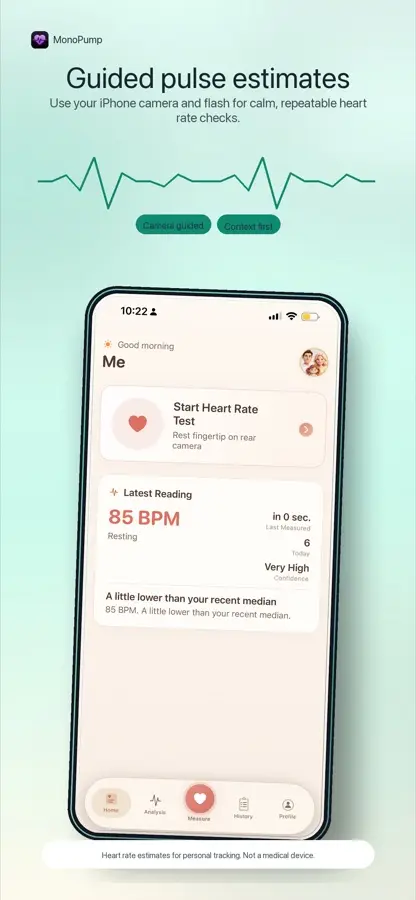
MonoPump helps turn camera-based pulse estimates into a private local record: guided capture, labels, notes, trends, and exportable reports for personal review.
In practice
Use MonoPump when one pulse reading is not enough and you want a private history with notes about rest, exercise, time, or measurement conditions.
Follow the camera-guided capture, review the estimate, add context, and compare saved readings or export a report for your own review.
Measurements and notes form a local personal record. Export is explicit, and the app is intended for personal tracking rather than medical diagnosis.
MonoPump engineering notes
Technical decisions, implementation details, and product context published for MonoPump.
How MonoPump keeps heart-rate history useful without turning private measurements into cloud data or medical claims.
Why MonoPump treats measurement as a staged state machine instead of a single start-and-stop camera action.
How MonoPump turns a cleaned PPG waveform into BPM using peak spacing, timestamp intervals, outlier filtering, and EMA smoothing.
How a stream of red-channel measurements becomes a usable PPG waveform through timing, detrending, smoothing, and buffering.
How MonoPump uses color ratios, brightness bounds, red dominance, and frame smoothing to decide when measurement can begin.
A practical explanation of how MonoPump turns camera frames, flash light, and blood-volume changes into a pulse signal.