

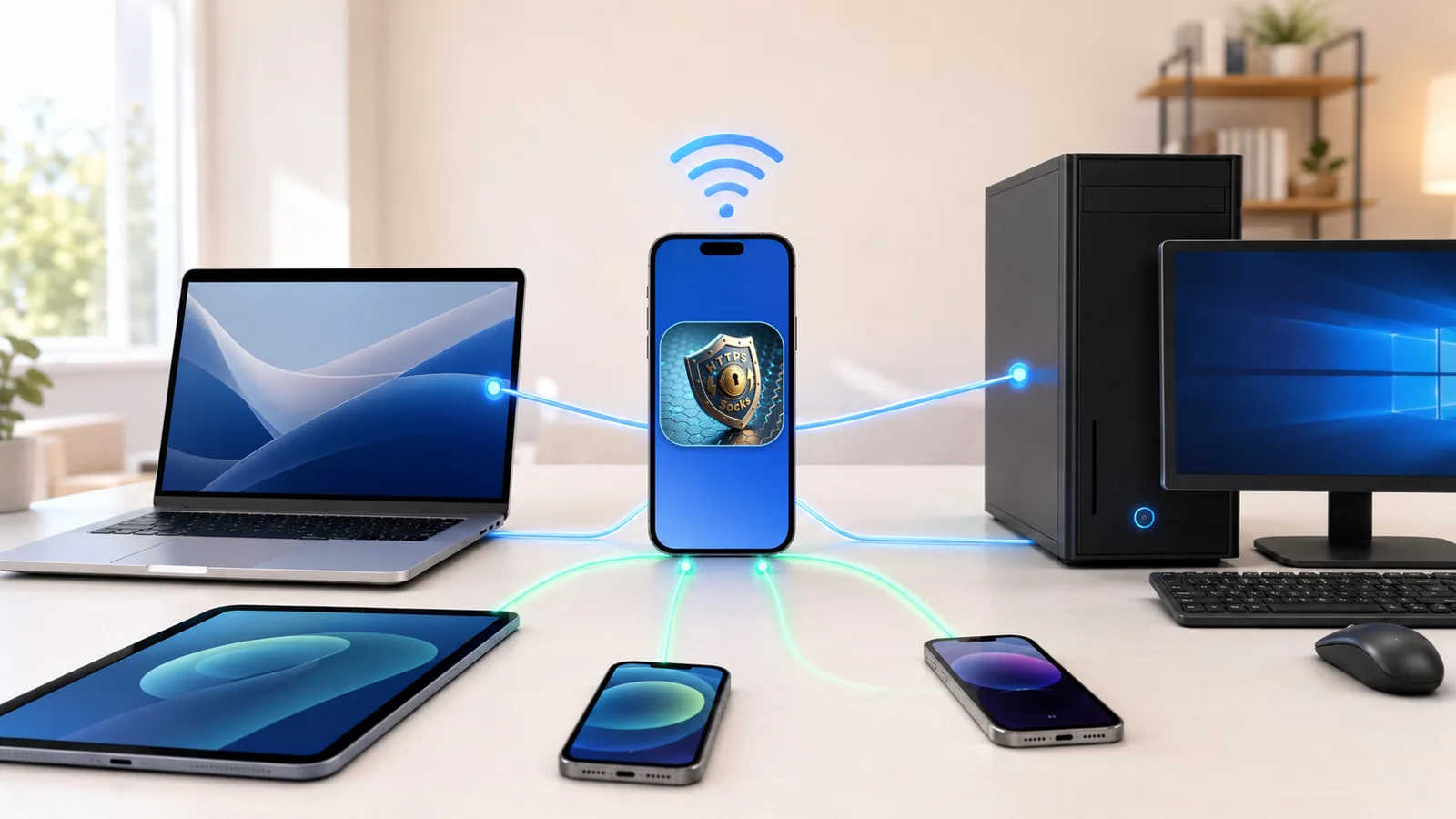
MonoProxy 2.3.1 is now available on the App Store for iPhone and iPad.
This release turns the original local HTTP proxy into a more complete private proxy hub. It now gives nearby Macs, PCs, tablets, and test devices one local endpoint for HTTP, HTTPS CONNECT, plain WebSocket, SOCKS4, SOCKS4a, and SOCKS5.
The goal has stayed deliberately narrow: start a proxy on a device you already have, share its configuration without unnecessary setup, and know whether real traffic is moving.
Start, share, verify
A proxy can open a port without being usable from another device. A client can reach the listener without sending successful traffic. MonoProxy now treats those as separate stages:
- Listening confirms that the selected address and port are ready.
- Client Connected confirms that another device reached the listener.
- Traffic Verified confirms that bytes actually crossed the proxy.
PAC URL and QR sharing are built into the setup flow. The app shows the active host and port, provides platform guidance, and makes it easier to configure one client before expanding the setup to more devices.
One endpoint for more protocols
MonoProxy 2.3.1 accepts multiple proxy protocols through the same local host and port:
- HTTP forward proxy
- HTTPS CONNECT tunnels
- Plain
ws://WebSocket forwarding - SOCKS4 and SOCKS4a
- SOCKS5 CONNECT with optional username and password authentication
The client still chooses the appropriate proxy type, while MonoProxy detects the incoming handshake and sends the connection through the matching path. This keeps multi-device setups simpler because there is one endpoint to share and remember.
Stronger control over local clients
A local network should not automatically be treated as a trusted network. Version 2.3.1 adds controls for deciding who can use the listener and how much capacity one client can consume:
- reusable proxy profiles;
- generated credentials, with profile passwords stored in Keychain;
- authentication failure protection;
- configurable per-client connection limits;
- private-network, IP address, and CIDR allow or block rules;
- the ability to disconnect an active session.
SOCKS4 does not support the password exchange used by SOCKS5. When authentication is required, MonoProxy rejects SOCKS4 instead of presenting it as a protected option.
Better evidence without HTTPS interception
The updated session views separate active connections from recently completed ones. On-device statistics show runtime, connection count, upload, download, and traffic trends. Optional site totals and history remain local and can be cleared.
The Diagnostic Center provides actionable checks for the listener, selected network interface, client presence, traffic, authentication failures, policy denials, capacity limits, failed sessions, and timeouts. Session reports can be exported with sensitive client and target addresses redacted.
MonoProxy does not install a certificate or decrypt HTTPS content. HTTPS CONNECT remains an opaque tunnel between the client and destination. The app reports connection and byte-level evidence without pretending to be a packet inspection tool.
More reliable under real network conditions
This update also strengthens the parts users should not have to think about:
- IPv4 and IPv6 handling;
- recovery when the selected network interface changes;
- large uploads and downloads;
- concurrent browser connections;
- half-closed connection draining;
- authenticated browsing across parallel requests.
Version 2.3.1 specifically fixes an authentication lockout that could incorrectly block normal concurrent browser connections. The integration suite now covers fragmented handshakes, coalesced payloads, repeated mixed-protocol cycles, connection bursts, large deterministic transfers, and authenticated SOCKS5 traffic.
Privacy and product boundaries
MonoProxy has no account, third-party analytics SDK, or remote traffic backend. Proxy credentials, optional history, traffic totals, and access policies remain on the device. HTTPS traffic is relayed without content decryption.
MonoProxy is a local proxy server. It is not a VPN, does not provide remote proxy locations, and does not route every app on the iPhone automatically. Client devices or applications must support proxy configuration and must be able to reach the iPhone or iPad on the current network.
The app is a one-time purchase. There is no subscription, in-app upgrade, or feature tier.
Available now
MonoProxy 2.3.1 supports iOS 15 and later and is available now on the App Store.
For feature details, privacy boundaries, and setup guides, visit the MonoProxy product guide.